Table of Contents
ToggleCENTRAL THESIS:
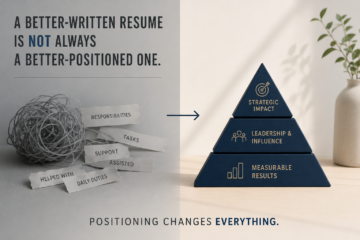
A resume rewrite fixes presentation. Career positioning fixes interpretation.
Most professionals assume they need a resume rewrite when their job search stalls.
Sometimes they do.
But often, the real problem is not the writing itself — it’s the positioning.
A resume rewrite improves wording, formatting, and organization. Career repositioning changes how employers interpret your value, leadership level, and business impact.
That distinction matters because strong professionals are frequently overlooked not because they lack experience, but because their resumes communicate the wrong level of professional identity.
In other words:
A resume can be well-written and still positioned incorrectly.
What a Resume Rewrite Actually Fixes
A resume rewrite improves the document itself.
That usually means:
- tightening the wording
- cleaning up the formatting
- organizing information more clearly
- updating outdated language
- making the resume easier to scan and read
For example, a resume rewrite might change:“Managed projects for multiple departments.”
into:“Led 12 cross-functional projects across operations, finance, and HR, improving completion timelines by 18% and reducing reporting delays by two weeks.””
Those things matter because if your resume looks messy, outdated, or hard to follow, it will hurt your chances fast.
That said, a better-written resume does not automatically change how employers see you. You can have a polished, ATS-friendly resume that still undersells your value.
It happens all the time.
- You might be an executive, but your resume still makes you look too tactical.
- You might lead sales teams and drive revenue growth, but your resume reads like you’re just an individual contributor.
- You might run operations strategically, but your resume positions you as administrative support.
At that point, the issue is not the writing. It’s the positioning.
Your experience may be strong, but if the resume frames it at the wrong level, employers will make the wrong assumptions about you.
That’s why career repositioning matters more than simply rewriting bullet points.
Career Positioning Changes How Employers Interpret You
Career repositioning focuses on how your experience is perceived within the context of the roles you want next. That requires a completely different level of strategy than simply improving the wording of a resume.
Instead of asking:
“How can we make this sound better?”
career positioning asks:
“What conclusions will employers draw from this experience?”
Because employers are constantly interpreting signals while reviewing resumes. They are trying to determine:
- what level you operate at
- whether your work was tactical or strategic
- how much influence you actually had
- whether you led initiatives or simply participated in them
- how your background aligns with the problems they need solved
If the resume communicates the wrong signals, employers will often place you into the wrong category entirely.
For example:
- A Director of Operations may unintentionally sound like a senior manager.
- A VP of Sales may appear too focused on individual production instead of organizational leadership.
- A transformation executive may communicate execution without clearly showing strategic influence or enterprise-wide impact.
Those perception gaps often have nothing to do with qualifications. They are interpreted through the lens of business value, leadership level, organizational impact, and risk.
That means strong professionals can be overlooked even when they have the right experience.
Not because they are unqualified. But because the positioning of their experience creates the wrong impression.
Career repositioning fixes that problem by reframing experience around:
- business impact
- strategic contribution
- leadership scope
- organizational influence
- measurable outcomes
- alignment with target-level opportunities
In other words, career positioning isn’t about making you sound more impressive. It’s about making the right professional identity unmistakably clear.
Career positioning is becoming more and more important for getting past ATS systems, tooOlder ATS systems mainly parsed keywords.
Modern hiring systems increasingly evaluate:
A resume that lacks strategic clarity no longer just creates confusion for humans, it increasingly creates weak signals within modern hiring ecosystems as well.
- context
- relevance
- consistency
- leadership signals
- alignment between experience and role level
Why Career Positioning Matters More in Modern Hiring Systems
For years, resume advice focused heavily on keywords and ATS optimization. That conversation is now evolving.
Modern hiring systems are becoming far more sophisticated in how they evaluate resumes. Many newer ATS integrations and AI-assisted screening tools are designed to assess not just keyword presence, but contextual alignment, leadership signals, role relevance, and consistency across a candidate’s experience.
In other words, hiring systems are becoming better at interpreting positioning.
That creates a major shift for experienced professionals. A resume that clearly communicates leadership scope, business impact, strategic influence, and organizational scale creates a very different signal than a resume filled with disconnected responsibilities and generic terminology.
For example, two candidates may both include phrases like “operations leadership,” “strategic planning,” or “revenue growth.”But if one resume demonstrates measurable organizational influence while the other reads like a list of responsibilities, employers — and increasingly, modern hiring systems — may interpret those candidates very differently.
This is one reason many professionals become frustrated during a job search. They know they have the right experience, but their resumes communicate fragmented information instead of a clear professional identity.
Once positioning becomes unclear, recruiters, hiring managers, and modern hiring systems can struggle to determine:
- what level the candidate truly operates at
- whether the experience reflects strategic or tactical work
- how the background aligns with the role
- whether the candidate fits the organization’s priorities
That is why career positioning has become more important than simply inserting additional keywords into a resume.
The challenge is no longer just visibility. It is interpretation.
So, what's the bottom line?
A resume rewrite can improve presentation.
Career repositioning changes how your experience is interpreted, evaluated, and aligned with higher-level opportunities.
In a hiring market increasingly driven by speed, context, and strategic relevance, that distinction has never mattered more.
Ready to transform your resume and stand out to employers? Let us help!
Our professional resume writing services will ensure your achievements are presented in the best possible light, so you win a coveted interview. Of course, if you're not quite ready to commit, you can try our free resume review to get personalized feedback and quick tips to strengthen your resume. Take the next step toward landing your dream job today!